
Artist Introductions
George E. Marston
The Artist of Antarctica
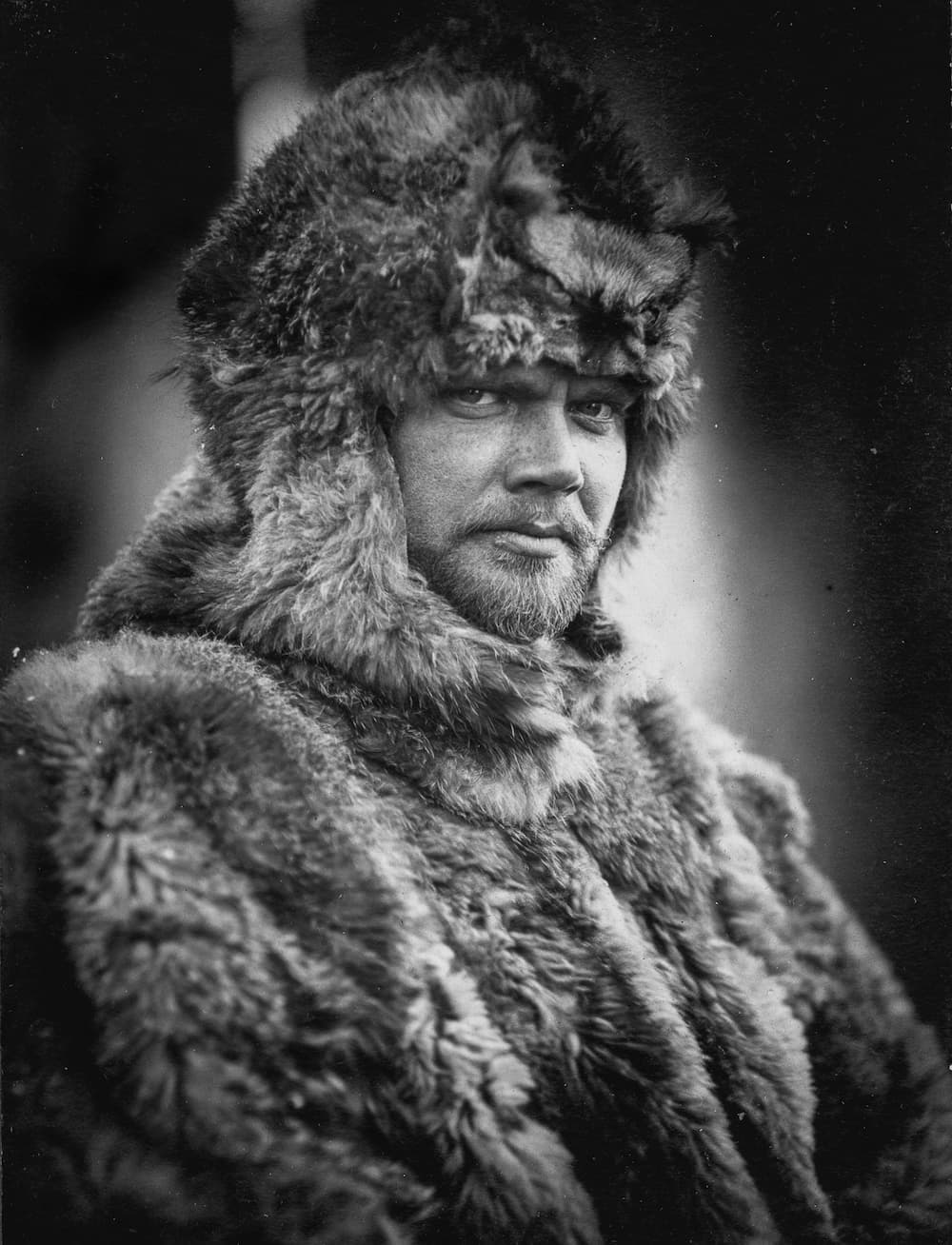
This week for Artist Introductions, I thought I’d write about George Marston. Born in Portsmouth, UK, in 1882, he is remembered above all as the artist onboard Ernest Shackleton’s ill-fated Imperial Trans-Antarctic Expedition from 1914 – 1917. Previously, he had also accompanied Shackleton on the Nimrod Expedition, which took place from 1907 – 1909 (this was Shackleton’s unsuccessful attempt to be the first to reach Antarctica, only getting within 97.5 nautical miles of the pole – he was beaten in 1912 by Norwegian explorer Roald Amundsen).
For explorers in the early twentieth century, it was all about breaking records. Seeing as Shackleton had fallen short of his original goal, the Trans-Antarctic Expedition aimed to cross Antarctica from sea to sea (read more about Shackleton and his adventures – he was a pretty interesting guy).

The journey is famous for disaster – the ship, Endurance, was crushed by polar ice before it reached the Antarctic mainland. The crew escaped and managed to camp on disintegrating sea ice. Eventually, they used a lifeboat known as the James Caird to travel to Elephant Island, an Antarctic ice mass located in the South Shetland Islands archipelago. As the lifeboat also began to disintegrate, Marston donated his oil paints to ‘caulk’ or patch up the boat, enabling the crew to eventually reach the closest inhabited island of South Georgia – 779 long and freezing miles away. Incredibly, everyone survived.
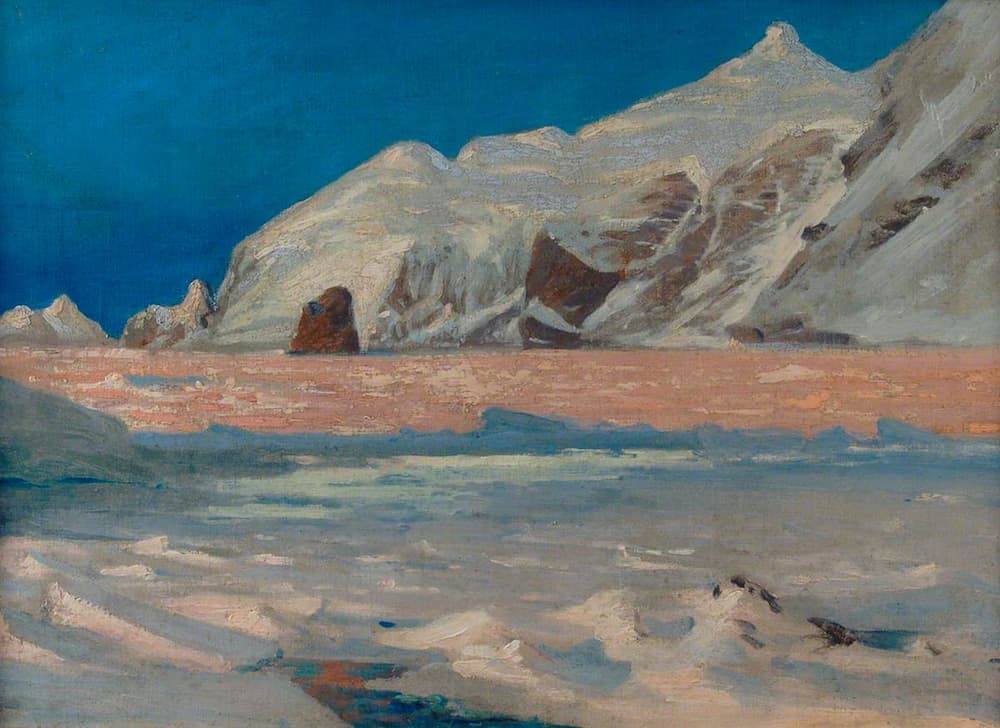
It is a brilliant tale of adventure and survival, and Marston provides us with an amazing visual insight into the expedition’s rugged and unforgiving backdrop. Due to his otherwise engaged oil paints, Marston completed his paintings upon his return to England, working from sketches. His oil on board paintings offer a valuable insight into the weather, topography, and equipment used during the expedition. His colour palette is predictably cool, but he also uses surprising warm tones to contrast the icy wasteland in paintings such as ‘Antarctic Sea and Landscape’.
Side note: as I was eagerly telling my dad all about Marston’s expedition, he asked me why the oil paint wouldn’t freeze in arctic temperatures. I did some Googling, and as far as I can tell, the linseed oil usually used in oil paint would freeze anywhere below -20°C. The average temperate in Antarctica is -57°C. So, the answer to my dad is: I have absolutely no idea how Marston’s oil paint did not simply freeze. If anyone would like to get in touch and let me know why, my dad and I would be very grateful!
I have selected a few of my favourite Marston paintings to give a sense of his work and the expeditions – I hope having a bit of background helps you to enjoy and appreciate his work even more.


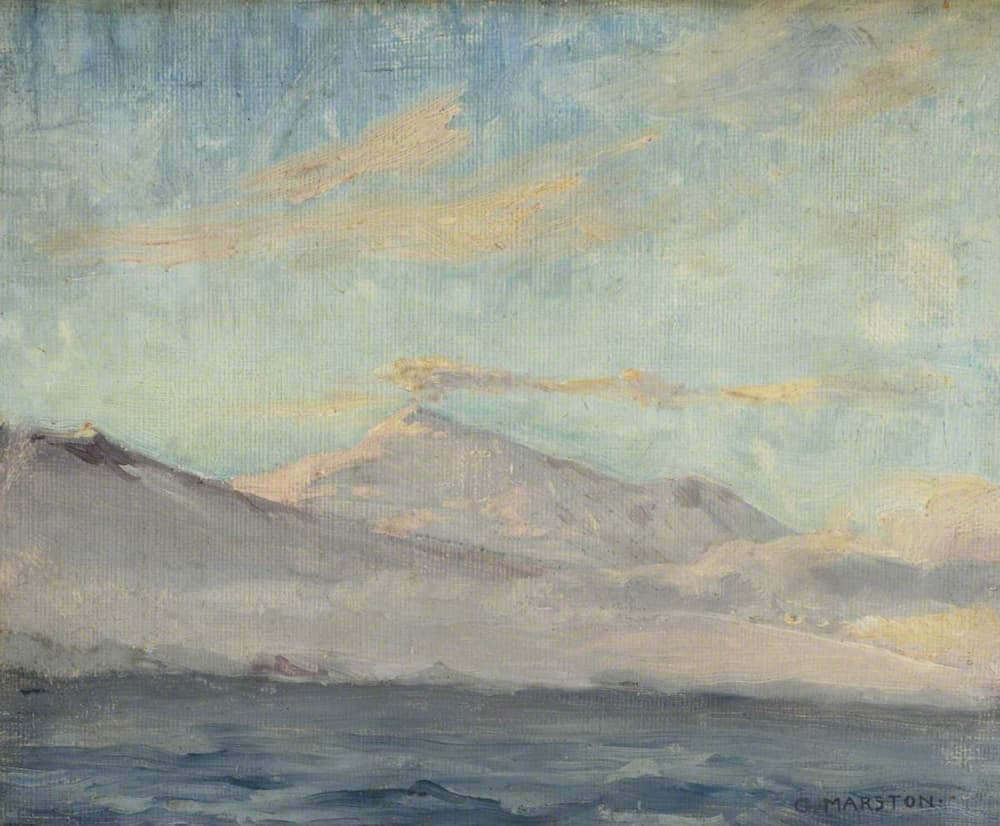
I like your choices – George (My grandfather) painted on Elephant Island under extremely difficult circumstances only a few water colours are in the sketch books – he only had a limited amount of paints left from the sinking of the ship. I think all his oil paints were used in caulking the Caird. With his few remaining water colours he managed to produce a number of works, as he explained in an introduction he wrote for an exhibition of Elephant Island pictures in 1922: ‘During the time of waiting, we were in a state of semi-starvation, the darkness of winter was around us, and opportunities for working were few, but with the returning daylight I was able occasionally to crawl out from our shelter under the upturned boats and make drawings. Having only water colours I was forced to colour them by the side of the blubber stove and by the light of the blubber lamp To protect them from damp and decay I made a case for them from old tent material, dog harness and a piece of my dog whip, and kept them in my sleeping bag, taking them out for an airing during the few fine days we experienced while there Some were unavoidable marked with spots of blubber oil- our principle article of diet- but in the circumstances I have made no effort to remove them’
Most of his work was recorded in notes and sketches using pencil and which he continually worked on until his death in 1940, By which time he was director of the Rural Industries Bureau (1934) and an important figure in the arts and craft movement.
Thanks for your precious words and for sharing your grandfather’s legacy with us
It is fantastic to hear from you Steve, what a wonderful insight. Thank you for sharing
George E. Marston’s oil paints did struggle in Antarctic cold, often freezing or becoming unusable, but he adapted by using them for practical purposes like sealing the lifeboat (the *James Caird), painting quickly in warmer conditions, and supplementing with other media, with his major works often painted after returning, though his diary notes the challenges of painting in extreme cold where linseed oil would typically freeze below -20°C.